
The Legend of Tetris
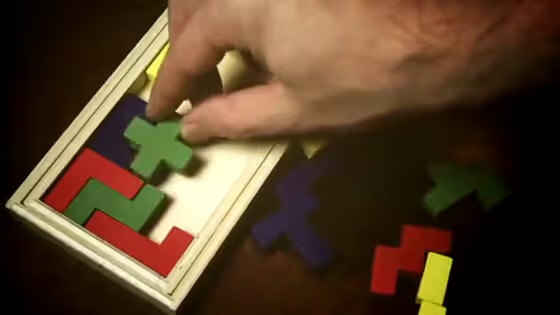
The story of Tetris starts with it's amazing creator Alexey Pajitnov. Pajitnov was born in Moscow in 1956 and was raised by his mother. As a boy, Alexey loved puzzle board games and movies of which James Bond was his favorite. One of the games he spent a lot of time with was Pentomino where the goal was to arrange 12 unique colored puzzle pieces consisting of 5 blocks each into a rectangle. The game was also going to be a basis for Tetris. Growing up, Alexey majored in Applied Mathematics at the Moscow Aviation Institute after which he worked as a Computer Engineer the Dorodnitsyn Computing Centre of the Soviet Academy of Sciences, a government R&D center. It was there where he created Tetris in 1984.
At that time, Alexey was working on two specific projects for the government, AI programming and Speech Recognition. The latter however was what the Soviets where keenly interested in. When not working and during his spare time, Pajitnov together with his friend and co-employee Dmitry Pavlovsky decided they wanted to make games. Of course at that time, there was still no Games Industry in the USSR (unlike in the West where it was already in full swing) so they decided to do it for the sake of doing it. They, where after all programmers.
Together with then 16 year old programming protégée Vadim Gerasimov who spent a lot of time hanging out with them (the Soviets also had their own Hacker culture) they embarked on a project to release a game pack for people in Russia who had access to computers to play with. Pajitnov worked on Tetris in his off-time ( but still in the lab no doubt) and after completing it couldn't stop beta testing it even during work hours. In 1984, Western made micro-computers (Apple, Commodore, BBC Micro, Atari, TRS-80 and the whole gamut of them) still hadn't made it yet to the Soviet Union. It was still Cold War era though Gorbachev was already around and would soon get tired of Communism.
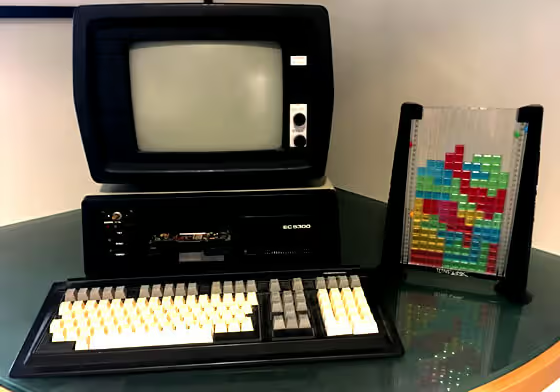
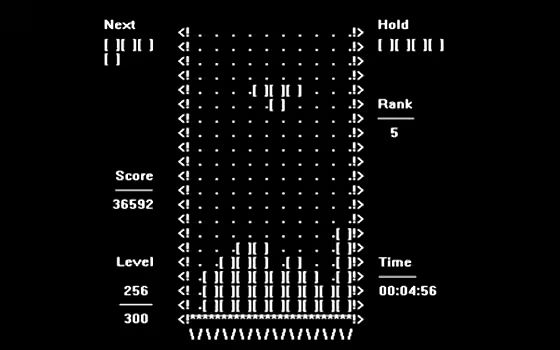
The trio developed their games on what was available at the computing center, the Electronika 60, a rack-mounted computer with no built-in display or storage device. It used an LSI-11 M2 CPU board (which was actually a Soviet clone of the DEC PDP-11) and had a total RAM of about 4-8KB. The CPU was usually paired with a 15IE-00-013 terminal and other I/O devices. As the Electronika was kind of like the PDP-11, it still didn't have a useable graphics processor circuitry so Pajitnov had to rely on a text based representation of his newly created puzzle game consisting of brackets and spaces. .
As mentioned, Tetris was based on Alexey's favorite Pentomino but adapting a puzzle board game to the dynamic digital realm presented blaring limitations of the board game that Alexey had to modify and redesign the game play concept. He also named it that way as a combination of the word Tetra and Tennis his favorite sport. Instead of just assembling the pieces together, he made them fall from the top of a rectangular game grid as they could be moved and rotated by the player so that it would fit well together when it lands on a stack of other pieces. These pieces, blocks or cubes (known as tetrominoes) have specific shapes and if they fit with the others when they land, they form a line and the whole stack moves a line downward and off the grid. The trick is to keep this going on as long as possible until the stack reaches the top of the grid and it's Game Over!
At first glance, it looked like a really boring game but when the other employees at the Computing Center (including Alexey's boss) started playing it, they where hooked. However, not many people in the USSR really has access to an Electronika 60 so aside from those who could, the game's user base was kind of small. This is where 16 year old Vadim Gerasimov came in. By 1986-1988, the IBM PC had reached the Soviets. With the help of Gerasimov who had to learn to program the early 8086-8088 processor PC's, Tetris was then ported over to the IBM PC. The result was a full color Tetris game which was initially distributed to friends, relatives and colleagues and eventually spread like wildfire in the whole USSR.
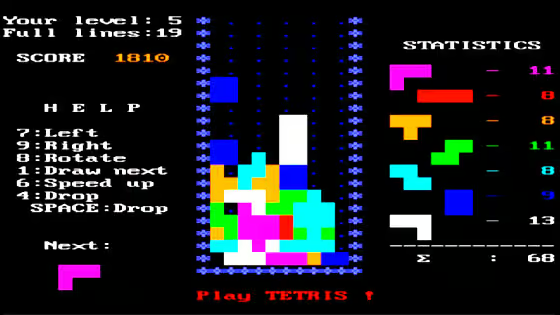
Due to it's popularity, the game reached the West by trickling through Hungary where it was ported by Eastern Block hackers to other micro-computer systems like the Commodore 64. Hungary during those times served as an open market between the Eastern block and the West. Apparently, in 1986, Alexey's boss sent a copy to a game publisher called Novotrade which was based there. Robert Stein, an international software salesman for a London based company called Andromeda Software then stumbled upon the game during a visit to the country.
Stein then contacted Alexey and his boss and was able to obtain a verbal agreement to license the game. In 1987, Stein was able to convince two companies to carry the game. Spectrum HoloByte in the US and MirrorSoft for Europe. Despite only having a verbal agreement with Pajitnov, Stein sold the rights of the game to the two companies for £3,000 and a royalty of 7.5 to 15% on sales. Spectrum Holobyte then repackaged the design and look of the game for Western gamers as it came out in a full red box with Cyrillic text which was very Soviet. MirrorSoft then released it in Europe for the IBM PC in 1987 while Spectrum Holobyte released it in the US in 1988. The game was a tremendous hit as MirrorSoft sold tens of thousands of copies in two months while Spectrum HoloByte sold over 100,000 copies within a year.
By that time, having discovered what Alexey had done and horrified by it, the Soviet Union's central organization for the import and export of computer software, Elektronorgtechnica ( Elorg )had taken over the rights of the game as it was deemed government property (there was no such thing as a soviet engineer moonlighting as a game designer and using government property to do it). Stein had to deal with them to obtain the still missing license. Elorg then agreed to it in 1988 for 80% of the game's revenue. Sadly, Alexey was prohibited from receiving any income or royalty from the game at this point as per Soviet rules.
At that time, Spectrum HoloByte sold the Japanese rights to its computer games and arcade machines to Henk Rogers of Bullet Proof Games based in Japan. Rogers had a Japanese wife. MirrorSoft on the other hand, sold its Japanese rights to Atari Games subsidiary Tengen, which then sold the arcade rights to Sega and the console rights to Rogers. The license of Tetris had revolved full circle with Elorg in the Soviet Union unaware of all this and still not earning from it. Meanwhile, the said companies where cashing-in on Pajitnov's puzzle game. Talk about Western capitalism.

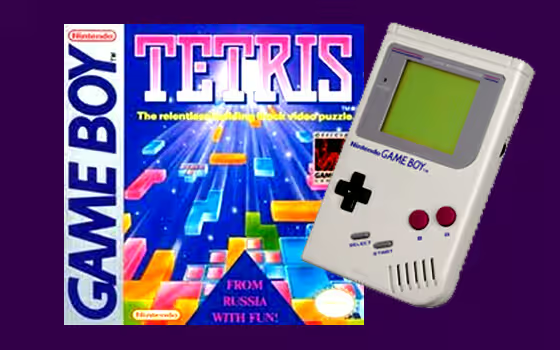
Nintendo also at that time was preparing to release its first portable console, the Game Boy. They saw Tetris and they liked it. Henk Rogers was close to then Nintendo president Hiroshi Yamauchi and sought to obtain the handheld rights of the game for the Game Boy. He first contacted Atari for it but to no avail, then Robert Stein but also got a vague answer. Finally, he decided to fly to Moscow himself and talk to the source, Elorg for it. What happened next was a historical turn of events for Tetris.
Unknown to Rogers, both Stein and MirrorSoft manager Kevin Maxwell traveled each separately to the USSR for the games licensing as well. Rogers unaware, beat them to it. Rogers walked into Elorg HQ without an appointment and explained to Elorg that he needed the license of Tetris for the Game Boy. Nikolai Belikov the chief of Elorg was confused especially when Rogers presented him with a Tetris console cartridge as Elorg had thought that the license was only for computing machines. They had no idea what a game console or a handheld was and Rogers had to explain it to them. It was there where he met Alexey Pajitnov and the two established a friendship (over a game of Go) that would last a lifetime.
Rogers was able to get the rights for the game for both home and handheld console for Nintendo. The contract with Elorg was signed by Nintendo's Minoru Arakawa and Howard Lincoln for $500,000, plus 50 cents per cartridge sold. Unfortunately again, Alexey had no cut in this. In 1989, Nintendo went into a furious court battle with Atari over the rights of the game for the Nintendo Famicom console version. Atari was still based on the original licensing of Stein and MirrorSoft for the games use with computers and not consoles so they lost to Nintendo. Atari was forced to withdrew its NES version from sale, and thousands of cartridges remained unsold in the company's warehouses.
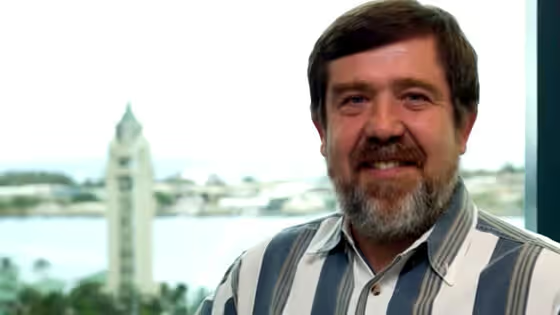
Throughout all these, Alexey Pajitnov became a celebrity in the West. He found out that Tetris had sold millions of copies and though he practically earned nothing, he remained humble and proud of the game and it's effect of bridging the gap between the West and the USSR. Then, the Berlin Wall fell and Gorbachev kicked Communism out the door. With the help of Henk Rogers, Alexey and his family immigrated to Seattle USA in 1991. There he started producing games for Spectrum HoloByte. In 1996, the rights first sold to Robert Stein for a period of 10 years expired. The rights of Tetris (technically) was reverted back to the original creator Alexey Pajitnov. That same year Pajitnov and Rogers started The Tetris Company which had the rights to Tetris along with Elorg. Also, from 1996 to 2005, Alexey worked for MicroSoft on their puzzle game projects. By 2002, Pajitnov and Rogers purchased the remaining rights from Elorg and established Tetris Holding which now holds the full rights to the game. As for Alexey's friends Dmitri and Vadim, they both immigrated to the US as well. Vadim though post-graduated from MIT and became an engineer for Google.
Tetris as a game success is huge. It has sold around 202 million copies, approximately 70 million physical units and 132 million paid mobile game downloads by December 2011. This makes it one of the best-selling video game franchises of all time! The Game Boy version of Tetris sold around 35 million copies. Also, the game holds the world record as the most ported game in the world as it is available for 65 different platforms. Not only that, Tetris is being used in both Mental and Psychological research with respect to effects like addiction, intelligence, therapy and other clinical studies and considerations. Now who ever thought that a simple digital puzzle game created by mild mannered Alexey Pajitnov in a Soviet computer lab would conquer the whole world in it's own simple way.
And that folks… is The Legend of Tetris.